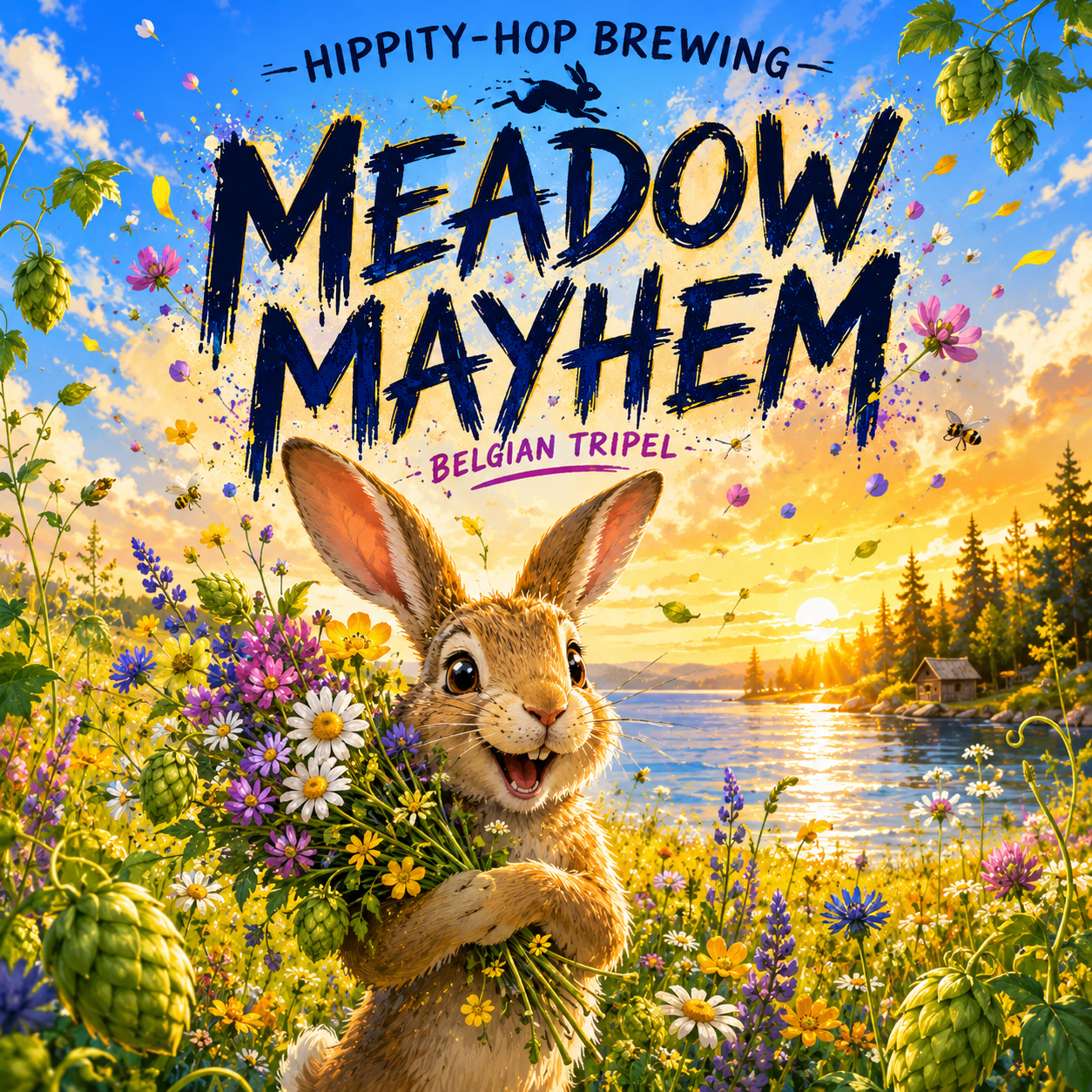
An account of floral ambition, questionable rabbit behaviour, and an unexpectedly magnificent Belgian Tripel.
Chapter I: The Rabbits Demand Something Extraordinary
It began on a peaceful Finnish lakeside, where the rabbits of Hippity-Hop Brewing had grown restless.
The brewery had produced its share of bold beers, but the rabbits wanted something different. Something elegant. Something floral. Something that tasted like a summer meadow yet possessed enough alcohol to make a Belgian monk question his life choices.
The brief was ambitious: a 21-litre Belgian Tripel, inspired by the creativity of Omnipollo, but without sacrificing the character that makes a Tripel a Tripel.
Naturally, the rabbits proposed throwing flowers into the kettle.
Chamomile! Tea! Lavender!
The head brewer rejected the lot.
The rabbits were disappointed, but the principle was established: ingredients would be selected for what they contributed, not for how exciting they sounded.
Chapter II: The Great Yeast Rebellion
The first major dispute concerned yeast.
The rabbits initially favoured the familiar Wyeast 3787, a long-standing favourite of the head brewer. It was reliable, expressive and capable of producing a magnificent Tripel.
But this beer needed a different personality.
The familiar pear and rich Belgian fruitiness were not what the rabbits sought. They wanted brightness, floral elegance and a lighter aromatic touch.
A succession of candidates appeared before the brewing council.
M31 arrived with impressive attenuation but brought rather too much phenolic baggage. BE-256 was deemed competent but uninspiring. Abbaye wandered into the wrong part of the flavour spectrum.
Then came Wyeast 1388 and its relative, WLP570.
The rabbits were fascinated by their Duvel-like character: bright, restrained and capable of a beautifully dry finish.
Unfortunately, 1388 had a reputation for occasionally deciding that fermentation was optional somewhere around 1.035.
WLP570 seemed promising, but the merchants had run out.
After considerable deliberation, the rabbits settled on WLP550 Belgian Ale.
An Ardennes strain. A little more expressive, potentially a touch peppery, but capable of producing the elegant Belgian character they wanted.
The yeast question was finally settled.
Or so they thought.
Chapter III: The Meadow Must Remain a Meadow
With yeast selected, attention turned to hops.
The rabbits briefly considered Nelson Sauvin, imagining exotic white-wine aromatics drifting across the lake.
The head brewer pointed out that Nelson had a habit of taking over the entire conversation.
Nelson was politely escorted from the premises.
Instead, the rabbits chose two European classics: Styrian Goldings and Hallertau Mittelfrüh.
The plan was simple. Hallertau would provide delicate herbal and floral structure. Styrian Goldings would supply the softer, meadow-like aromatics. Magnum would handle the bittering without demanding attention.
The eventual hop bill was restrained but purposeful:
| Hop | Amount | Addition |
|---|---|---|
| Magnum | 25 g | 30 minutes |
| Hallertau Mittelfrüh | 20 g | 15 minutes |
| Savinjski Golding | 50 g | 80°C hop stand |
| Hallertau Mittelfrüh | 30 g | 80°C hop stand |
No tropical fruit explosion. No aggressive dry hopping. No hop arms race.
The rabbits had discovered restraint.
It was an unfamiliar sensation.
Chapter IV: The Great Malt Extract Controversy
The next challenge came from the grain store.
The brewery was working with malt extract, and the rabbits understood the difficulty: a strong extract-based Tripel could finish too sweet, particularly when the yeast encountered a substantial proportion of unfermentable carbohydrates.
One rabbit suggested Vienna Red extract.
It promised honeyed malt complexity, richer colour and a more distinctive character.
The brewing council examined the idea against BJCP Tripel guidelines.
Too dark. Too malty. Too much bread crust.
The rabbits reluctantly returned the Vienna Red to the shelf.
Instead, they chose a deliberately pale extract base, supported by a substantial quantity of golden syrup.
The fermentables
| Fermentable | Amount |
|---|---|
| Briess Golden Light LME | 4.0 kg |
| Extra Light DME | 0.5 kg |
| Golden syrup | 2.0 kg |
The golden syrup caused considerable debate.
Was 2 kg excessive? Would it create fermentation stress? Should it be introduced in stages?
The rabbits eventually tipped the entire quantity into the kettle.
Their reasoning was that a healthy yeast pitch could handle the initial gravity, while the highly fermentable sugar would help produce the dry finish they wanted.
It was a calculated gamble.
Chapter V: The Bottle Erupts
Before brew day, WLP550 received a vitality starter.
The rabbits watched with interest.
Then with concern.
Then from a safe distance.
The yeast erupted out of its glass bottle in a spectacular display of foam.
One rabbit declared it a disaster.
Another called it an encouraging sign.
The head brewer simply prepared the conical fermenter.
The wort entered at 1.087 original gravity, and the yeast was pitched at 18°C.
The rabbits were instructed to keep their paws away from the temperature controller.
For approximately three days, they complied.
Chapter VI: The Long, Anxious Descent
Fermentation began with extraordinary enthusiasm.
By day three, gravity had fallen from 1.087 to 1.033.
The rabbits celebrated.
Then the fermentation slowed.
The next twelve hours produced only four additional gravity points. Some rabbits began drawing up emergency plans involving Voss kveik, additional nutrients and increasingly elaborate rescue operations.
The head brewer remained unconvinced.
The yeast was still working. It had simply entered the slower phase of fermentation.
The temperature was raised to 22°C.
By just under day five, gravity reached 1.026.
Progress, but the final result remained uncertain.
The original recipe software had predicted a relatively high final gravity. The rabbits knew that if the beer finished too sweet, the whole summer Tripel concept could collapse under its own weight.
So the temperature was raised again, eventually reaching 24°C.
The yeast was given another day.
And the rabbits waited.
Chapter VII: The EasyDens Delivers Its Verdict
At last, the head brewer collected a sample.
The rabbits gathered around the EasyDens.
Meadow Mayhem: final fermentation results
| Measurement | Result |
|---|---|
| Original gravity | 1.087 |
| Final gravity | 1.013 |
| Apparent attenuation | 85% |
| Estimated alcohol | 9.7% ABV |
The rabbits stared at the instrument.
Then at each other.
Then at the head brewer.
The extract-based Tripel had finished remarkably dry.
But the numbers were only half the story.
The first tasting revealed something even more satisfying.
A perfectly balanced floral character. No banana. No overwhelming pepper. No excessive sweetness.
The hops and yeast had integrated into something soft, delicate and surprisingly drinkable.
The head brewer described it as almost tender.
At nearly 10% alcohol, this seemed faintly ridiculous.
The rabbits considered it their finest achievement.
Chapter VIII: The Carbonation Contraption
Of course, the rabbits were not content to stop at successful fermentation.
A proper Tripel needed carbonation.
Not ordinary carbonation.
Three full volumes of CO₂.
Unfortunately, the brewery’s existing serving arrangements were not ideally suited to this.
The obvious solution would have been to compromise.
The rabbits instead built independent pressure control.
The finished beer was transferred into a 19-litre keg, containing approximately 18.5 litres of Meadow Mayhem.
The keg was chilled to 4°C, with the regulator set around 1.25 bar for equilibrium carbonation.
The rabbits now had a beer designed not merely to be tasted once, but to evolve on tap over the following six months.
Fresh meadow flowers might gradually soften into honeyed herbal notes. The yeast character could become more integrated. The alcohol might become even less apparent.
Only time would tell.
And the rabbits had every intention of conducting extensive research.
Epilogue: What the Rabbits Learnt
Meadow Mayhem was supposed to be an exercise in creative excess.
Instead, it became a lesson in deliberate restraint.
The rabbits had explored exotic hops, botanical additions, alternative yeasts, unusual malt extracts and fermentation rescue strategies.
Most were discarded.
What survived was a relatively simple recipe whose ingredients had been chosen with care, supported by a fermentation process that was monitored, questioned and adjusted when necessary.
The beer succeeded not because everything imaginable had been added, but because everything unnecessary had been left out.
And somewhere beside a quiet Finnish lake, a rabbit raised a glass of sparkling golden beer, inhaled the delicate scent of wildflowers, and made a deeply irresponsible decision to have another.
Meadow Mayhem: Belgian Tripel
Born from chaos. Perfected by restraint. Approved by rabbits.