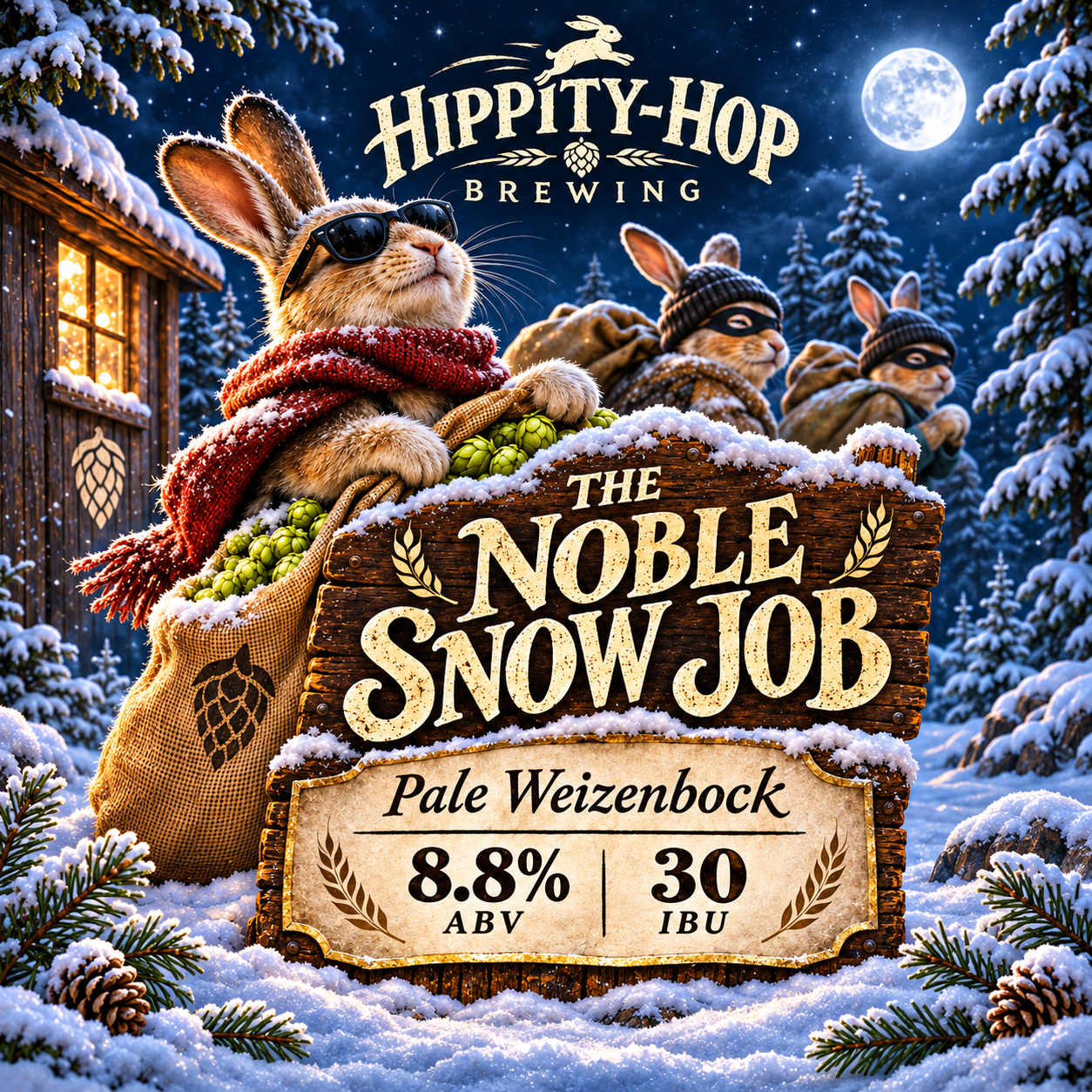
An innocent-looking wheat beer, a gang of ambitious rabbits, and a rather suspicious amount of alcohol.
Winter was approaching Hippity-Hop Brewing, and the brewery faced a familiar dilemma. The heart wanted another enormous, extravagantly hopped Double IPA. The calendar, however, had other ideas.
With precious little time for brewing and conditioning, something different was called for. Something uncomplicated. Something that could deliver serious flavour without weeks of hop-heavy maturation.
The answer came from an unlikely direction: a Bavarian wheat beer.
Now, wheat beers are generally associated with sunshine, summer terraces and refreshment. But what if we took that familiar combination of banana, clove and soft wheat malt, gave it a richer backbone, and pushed the strength into proper winter territory?
A pale Weizenbock was born.
And somewhere in the snow-covered woods, a group of rabbits began planning a heist.
A deceptively simple plan
The brewing philosophy was straightforward: let the ingredients do what they do best.
A decoction-mashed Weyermann Bavarian Hefeweizen malt extract would provide the foundation, supported by wheat extract and a little golden syrup. Magnum would handle the bitterness, with Hallertau Mittelfrüh providing a subtle noble-hop flourish.
No elaborate water chemistry. No complicated mash schedule. No dry hopping. Just soft, naturally low-mineral well water, good wort and a healthy population of LalBrew Munich Classic.
The yeast was entrusted with the most important job: creating the characteristic banana esters and clove phenols that make German wheat beers so fascinating.
The target was a beautifully balanced, deceptively drinkable 8% winter wheat beer.
The rabbits, naturally, had other plans.
The gravity heist
The first indication of trouble arrived before the boil was even complete.
The brewing software had confidently predicted an original gravity of 1.078. The EasyDens, apparently unaware of the agreed plan, announced something considerably more ambitious.
After boiling, the wort measured a magnificent 1.090.
Somewhere, a rabbit was making off with an entire sack of extra gravity points.
Fortunately, the reduced volume transferred into the fermenter provided an unexpected benefit: additional headspace. And with nearly 20 litres of high-gravity wheat wort and two sachets of Munich Classic ready to unleash themselves, every centimetre was welcome.
The blow-off tube was installed.
The yeast gods were consulted.
And the heist began.
The great fermentation getaway
For the first 24 hours, things appeared remarkably civilised.
Then Munich Classic woke up.
Between hours 24 and 48, gravity plummeted from 1.080 to 1.050. The kräusen rose enthusiastically, the blow-off tube earned its keep, and the rabbits made their initial escape with an impressive quantity of fermentable loot.
The temperature followed a deliberately controlled progression, beginning at 19°C and gradually rising to 21°C during vigorous fermentation.
But as alcohol accumulated, the getaway became increasingly difficult.
By day four, gravity had reached 1.032. By day five, 1.028. The once-explosive fermentation had become a determined trudge through increasingly deep snow.
The temperature was raised to 23°C, eventually reaching 24°C to help the yeast finish its demanding assignment.
And slowly, patiently, Munich Classic continued.
Day six: 1.026.
Day seven: 1.025.
Day eight: 1.023.
Day nine: 1.022.
By day ten, the Tilt was reporting 1.021. The rabbits had clearly abandoned their original escape timetable, but they weren’t leaving any easily accessible fermentables behind.
Eventually, three days of stable readings suggested the heist was complete.
The EasyDens confirmed a final gravity of 1.023.
The result? A distinctly unplanned but thoroughly welcome 8.8% ABV.
The evidence is delicious
The first sample revealed something rather wonderful.
We had deliberately aimed for balanced banana and clove character. What emerged was something even more interesting: a fermentation profile so beautifully integrated that neither character demanded individual attention.
Instead, the beer presented a smooth, slightly floral complexity, backed by rounded malt sweetness and an almost velvety softness.
Remarkably, the initial impression was closer to a particularly elegant Belgian strong ale than an exaggerated Bavarian wheat beer.
And therein lies the magic.
No fruit additions. No exotic flavourings. No elaborate ingredient combinations.
Just carefully prepared malt extract and a microorganism capable of transforming relatively ordinary wort into something extraordinarily expressive.
The malt provides the stage. The yeast creates the performance.
At nearly 9% ABV, the resulting warmth and gentle sweetness also feel entirely at home in a Finnish winter. What began as a style traditionally associated with summer has become a rather convincing cold-weather companion.
Once chilled and generously carbonated, we’re expecting the lively wheat-beer effervescence to provide a refreshing counterpoint to all that malt richness.
The Noble Snow Job
Pale Weizenbock | 8.8% ABV | 30 IBU
A strong, golden winter wheat beer built around decoction-derived malt character, expressive Bavarian yeast and a restrained touch of noble hops.
Soft wheat, integrated banana and clove, delicate floral complexity and rounded sweetness conceal a rather formidable alcoholic payload.
The first samples suggest that the rabbits have pulled off something exceptional. The final verdict awaits the fully conditioned beer.
The plan was simple. The gravity was not. The yeast was magnificent.
The perfect crime: everyone enjoys the evidence.
Hippity-Hop Brewing. Friendly chaos. Serious beer.