Or: how several rabbits turned an Old Ale into something rather less straightforward
It began, as these things often do at Hippity-Hop Brewing, with an entirely reasonable idea.
Christmas deserved a beer.
Not a beer for the meal itself, nor something to absent-mindedly drink while presents were being opened. This was to be the beer for afterwards: when the cooking was finished, the dishes were done, the house had finally become quiet and one could sit down with a single bottle and nowhere else left to be.
The precedent was formidable. Belgian Tripels and Quads had occupied the role before. So had Imperial Stout and, most recently, a particularly successful Wee Heavy fermented with Verdant IPA yeast. It was a devilishly fruity malt monster that had somehow retained the ability to disappear from the glass with alarming ease.
For this year, however, somebody mentioned Old Ale.
A rabbit nearby pretended not to hear.
The first peculiar idea
The Old Ale seemed promising precisely because it offered depth without requiring spectacle. Malt, fruit, warmth, time. All the components of a contemplative Christmas beer were already there.
But ordinary brown would not do.
The thought emerged that perhaps the beer could be red.
Not reddish-brown according to a brewing-software colour chart. Actually ruby. A deep winter-sunset colour that would make the glass itself part of the story.
That was when Weyermann Vienna Red extract entered the conversation.
It was hardly the obvious foundation for an English Old Ale: Pilsner, Vienna and melanoidin malts condensed into a German liquid extract. Yet it offered exactly the combination required: bread, malt depth and red-amber colour without steeping grains, while fitting the practical constraints of a thirty-minute extract brew.
The rabbits approved immediately, which should perhaps have been taken as a warning.
The beer was becoming an Old Ale constructed from decidedly non-Old-Ale pieces.
Then came the yeast
A conventional British strain would have been easy.
That was therefore rejected.
Several candidates were interrogated. WLP007 offered reassuring attenuation but perhaps too much restraint. Burton promised apple, pear and honey. West Yorkshire sounded magnificent but threatened to leave a 9% extract beer with the consistency of Christmas pudding. Verdant remained the proven emergency weapon.
Then WLP4000 Vermont Ale appeared.
A modern American ale yeast, famous for hop-forward beers, bringing peach, apricot and citrus into an English strong ale built on German malt extract.
Perfectly sensible.
The geographical situation was becoming difficult to explain.
The developing beer now had the malt depth of English Old Ale, aspirations towards the ruby glow of Irish Red Ale, German-Vienna malt architecture and the fruit expression of modern American brewing. English Challenger and East Kent Goldings were eventually appointed to restore some order.
They failed.
The sugar negotiations
The beer still needed to finish dry enough that half a litre after Christmas dinner would feel like a reward rather than a contractual obligation.
Finnish vaalea siirappi was selected for the job.
There was briefly a moment when 2.2 kilograms of it appeared in the recipe.
Even by rabbit standards, this was excessive.
The quantity retreated to 1.2 kilograms, joined by 4 kilograms of Vienna Red LME and 1.5 kilograms of extra-light DME. The recipe settled around a predicted OG of 1.086, FG of 1.017, approximately 9% ABV and 44 IBU.
The brewing salts were similarly disciplined. The original sulphate-heavy treatment was pulled back to a balanced addition of gypsum and calcium chloride for the extremely soft spring water.
For a brief moment everything appeared under control.
Brew day
The rabbits waited.
The target gravity was 1.086.
The wort measured 1.095.
Nobody admitted responsibility.
The beer had suddenly acquired nine additional gravity points and was now clearly heading towards 10% territory.
Fortunately, a 900 ml vitality starter of WLP4000 had already been prepared. It looked hazy and not especially theatrical, but showed enough signs of life to justify the gamble. Two packets of Verdant waited nearby in case Vermont declined the assignment.
It did not.
The fermentation began.
The long descent
At first the gravity fell enthusiastically:
1.095. 1.083. 1.059. 1.047.
Then, as the easy sugars disappeared and the alcohol level climbed, the yeast changed gear.
The fermentation temperature was allowed to rise from its cool 18°C start towards 20°C and ultimately 22°C. By then most of the ester-defining growth phase had passed; the priority had become persuading the yeast to finish the considerable job it had been given.
After seven days the beer was at 1.026 and still moving.
It was left alone.
Eventually, after sixteen days, WLP4000 declared negotiations complete at 1.024.
There was mild annoyance.
The intended 1.017 had not happened. But neither had catastrophe.
From 1.095 to 1.024 the beer had reached approximately 9.3% ABV. The 44 IBU of Challenger and East Kent Goldings remained available to counter the residual malt richness. The beer was strong, fruity and substantial, but not obviously doomed to become syrup.
The yeast was dumped.
And beneath the brown fermentation haze, there was finally a hint of red.
A month beside the frozen lake
The beer went cold.
At 4°C, under carbonation, the remaining yeast slowly withdrew and the beer began becoming itself.
The promised brilliant ruby had not emerged as initially imagined. Instead the colour settled somewhere more mysterious: brown and mahogany in ordinary light, with garnet-red appearing when illumination passed through it.
This was arguably better.
The beer no longer looked engineered to match a colour specification. It looked like something that might change depending on when and where you looked at it.
Which led naturally to the name.
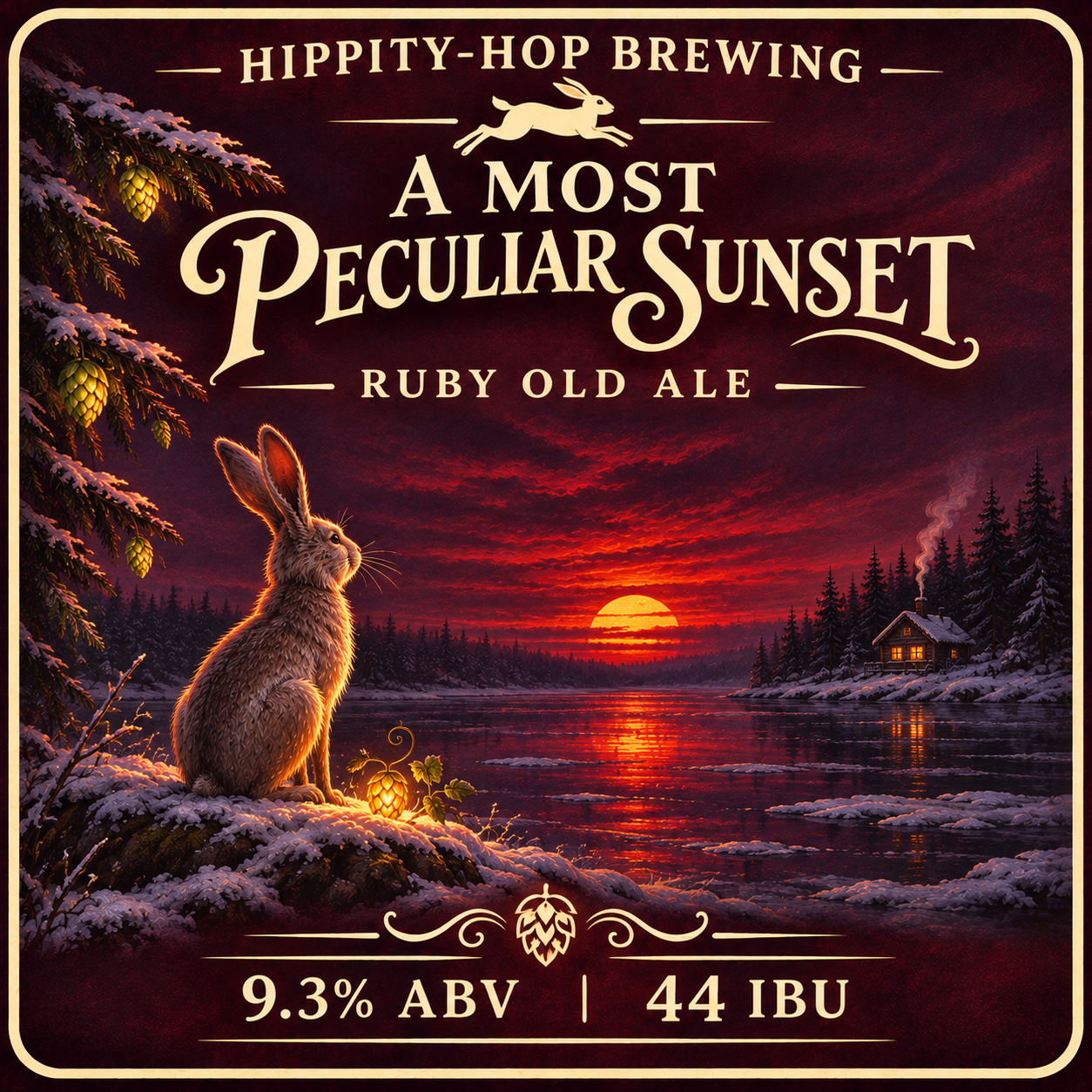
A Most Peculiar Sunset
Peach and apricot from WLP4000 sat over rich malt. Challenger and East Kent Goldings countered the residual sweetness of a 1.024 finish. At 9.3% ABV, it was warming and complex, yet deceptively easy to drink.
Pour gently and let it warm towards 10–12°C. The garnet appears as light passes through the glass, while the fruit and malt have time to reveal themselves.
What finally emerged
A Most Peculiar Sunset did not become exactly the beer that was designed.
That is probably why it became a better Hippity-Hop beer.
It began as a 9% ruby Old Ale and finished as a 9.3% category-bending strong ale, fermented from an unexpectedly enormous 1.095 wort, finishing richer than intended at 1.024, carrying 44 IBU of English hops and an expressive peach-and-apricot fermentation character from Vermont Ale yeast.
Its colour refused to be simply red.
Its nationality became impossible to establish.
Its yeast came from the wrong beer tradition.
Its gravity escaped supervision.
And yet every deviation ultimately remained subordinate to the original purpose:
One special bottle, opened when Christmas Day has finally become quiet, poured into a glass and given enough time to reveal what has been hiding in it.
Serious brewing underneath.
A little mayhem around the edges.
And, naturally, no reliable witnesses except the rabbits.