An account of academic triumph, questionable rabbit supervision, and the unexpected importance of a beer engine.
Hippity-Hop Brewing · Somewhere beside a Finnish lake
It began, as many great rabbit-related incidents do, with an entirely reasonable idea.
The Head Brewer of Hippity-Hop Brewing had completed a one-year master’s programme in Industrial Management, building on his earlier studies. A year of studying, planning, analysing, revising and optimising had finally reached its conclusion.
Naturally, such an achievement demanded a beer.
Not another enormous stout. Not a tropical hop explosion. Something altogether more civilised.
A proper British golden ale. About five per cent alcohol. Floral, citrusy, beautifully balanced and eminently drinkable.
The rabbits were summoned.
Chapter I: The Committee of Questionable Decisions
The initial proposal was straightforward: 20 litres of British golden ale, brewed with liquid malt extract, no steeping grains and traditional British hops. The batch size would change later. At this stage, nobody thought that worth mentioning.
Challenger would provide the bittering backbone. East Kent Goldings and, initially, Styrian Goldings would furnish the flowers and citrus. The whole affair would be completed with a convenient 30-minute boil.
There was, however, the matter of yeast.
The first rabbit, wearing spectacles and carrying an unnecessarily large clipboard, proposed LalBrew Windsor.
“Splendid British character!” it declared. “Fruitiness! Tradition! A properly rounded pint!”
The second rabbit consulted the technical documentation.
“Doesn’t ferment maltotriose.”
Silence.
The Head Brewer frowned. A sweet, sluggish golden ale was not what anybody had commissioned.
After several heated meetings, the rabbits introduced golden syrup to the formulation. A thoroughly British solution: replace a portion of the malt extract with readily fermentable sugar to improve drinkability.
The first proposal contained 300 grams.
The rabbits subsequently increased it.
Then increased it again.
Eventually, 500 grams of golden syrup found its way into the recipe.
The committee described this as strategic fermentability optimisation.
Everybody else called it adding sugar.
Chapter II: The Great Extract Restructuring
The original formulation featured 3.6 kilograms of British pale malt extract.
Unfortunately, the practical realities of ingredient availability intervened.
Briess Pale Ale LME entered the picture, producing a projected colour of 11.4 EBC. Perfectly respectable, but rather darker than the golden sunshine the rabbits had envisioned.
A procurement rabbit arrived carrying alternative malt specifications, several empty cartons and a distinctly concerning spreadsheet.
After considering lighter extracts and the relative merits of wheat versus pale dry malt extract, the team settled on a lighter formulation.
The ratified fermentables
| Ingredient | Quantity |
|---|---|
| Briess Golden Light LME | 3.0 kg |
| Muntons Light Spraymalt DME | 500 g |
| Golden syrup | 500 g |
Projected colour: 8.1 EBC. A properly golden outcome.
The recipe had survived its first major restructuring.
The rabbits congratulated themselves on their excellent change-management procedures, conveniently overlooking the fact that they had caused most of the changes.
Chapter III: The Yeast Rebellion
Windsor, meanwhile, was becoming a source of considerable political instability within the brewery.
The more the Head Brewer investigated, the less convinced he became.
Its maltotriose limitation was already understood, but now concerns about attenuation, flavour predictability and suitability for a relatively lean extract-based golden ale were mounting.
The rabbits established a Yeast Selection Subcommittee.
It was a disaster.
LalBrew London was nominated. SafAle S-04 received strong support from the traditionalists. Nottingham was deemed dependable but insufficiently theatrical.
Then somebody introduced Verdant IPA.
The creative rabbits immediately began discussing apricots, peaches and modern British pale ales.
The traditionalists accused them of attempting to turn a respectable pub beer into a tropical fruit salad.
London Ale III entered the discussion, causing further confusion when everyone realised how closely related the Verdant concept was to the alternative now being proposed.
Finally, WHC British Pub Ale emerged as a promising compromise: traditional British character, restrained fruitiness and a fermentation profile better aligned with the beer’s ambitions.
Pitching rates and fermentation temperatures were debated with the seriousness normally reserved for industrial capital investments.
The rabbit responsible for process control proposed fermenting cool initially and allowing a controlled temperature rise.
For once, nobody objected.
The committee had arrived at a sensible conclusion.
At least on paper.
Chapter IV: Approved With Minor Revisions
Somewhere during these proceedings, an important question emerged.
What should the beer be called?
A number of proposals crossed the committee’s desk. Some referenced managerial chaos. Others involved hare-related disasters, suspiciously peaceful lakes and questionable academic decisions.
But one name stood above the others.
Approved With Minor Revisions.
It was wonderfully appropriate.
The master’s degree had been completed. The beer was being designed through a seemingly endless sequence of evaluations and modifications. And the rabbits, despite their manifest incompetence in administrative matters, had somehow assembled something rather promising.
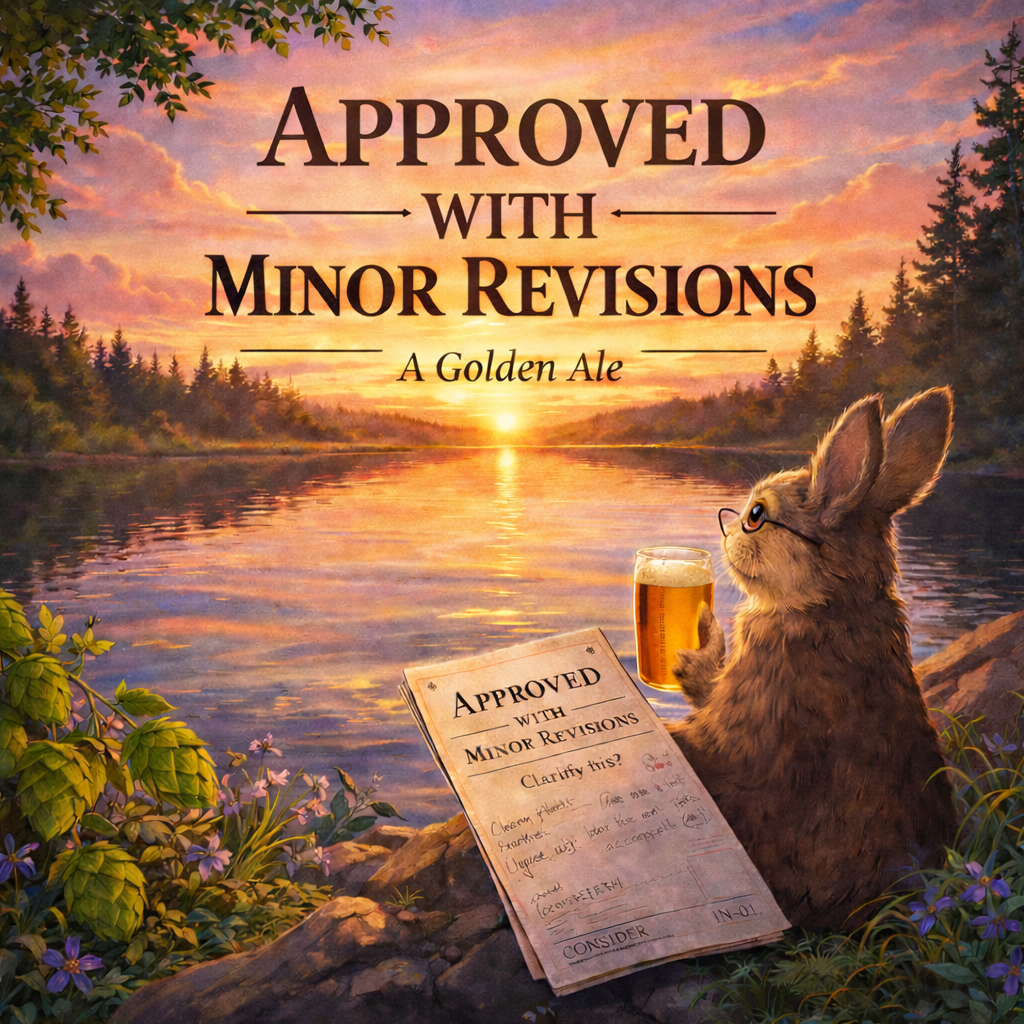
The label depicted the aftermath: a scholarly rabbit, spectacles perched upon its nose, enjoying a well-earned golden pint beside a peaceful Finnish lake at sunset.
Academic papers lay nearby.
The day was ending.
The work was done.
British pub-style lettering completed the composition, adding a sense of heritage to the distinctly Nordic surroundings.
For the first time, the rabbits looked satisfied.
Then somebody requested another recipe revision.
Chapter V: The Final Final Final Recipe
The brewing committee eventually delivered its approved specification.
Recipe design targets, before brewing
British Golden Ale · 30-minute boil
| Specification | Design figure |
|---|---|
| Batch size | 23 L |
| Original gravity (OG) | 1.049 |
| Final gravity (FG) | 1.012 |
| Alcohol by volume (ABV) | 4.86% |
| Bitterness | 35.2 IBU |
| Colour | 8.1 EBC |
These are documented recipe targets and projections, not a complete set of measured results from the finished beer. The beer record lists the final beer at 5.4% ABV and 36 IBU.
Fermentables: 3.0 kg Briess Golden Light LME, 500 g Muntons Light Spraymalt DME and 500 g golden syrup.
Hop schedule
| Addition | Quantity | Timing |
|---|---|---|
| Challenger | 35 g | 30 minutes before the end of the boil |
| East Kent Goldings | 25 g | 10 minutes before the end |
| East Kent Goldings | 25 g | 5 minutes before the end |
| East Kent Goldings | 15 g | 10-minute hop stand at 80 °C |
Water additions: 6 g gypsum, 2 g calcium chloride and 1 g Epsom salt, plus yeast nutrient.
Fermentation plan: Start at 18 °C, rise through 20 °C and finish at 21 °C.
Yeast record: WHC British Pub Ale was the final candidate discussed. The yeast actually pitched has not been confirmed in the available brewing notes.
There it was.
A beer designed to be balanced, floral, gently fruity, moderately bitter and refreshing.
The rabbits stamped the paperwork.
Then removed the stamp from the label artwork because the word Approved made it redundant.
A small but important victory for visual design.
Chapter VI: The Unexpected Triumph of the Beer Engine
And finally, the beer was brewed.
The rabbits waited.
Would the malt extract deliver sufficient complexity? Would the bitterness overwhelm the floral character? Would all the fermentation deliberations actually amount to anything?
The first impressions were encouraging.
The beer was balanced. Pleasant. Drinkable.
But something was missing.
From a conventional tap, the golden ale threatened to be merely agreeable. A perfectly decent beer, perhaps, but not the memorable pint the committee had laboured to create.
Then the beer engine entered the story.
And everything changed.
Hand-pulled dispense brought the beer’s softer characteristics to the forefront. Fruity notes and delicate floral hopping became more apparent. The carbonation no longer competed so strongly with the subtler flavours, and the beer acquired the gentle presentation of a proper British pub pint.
The golden ale had finally found its voice.
The rabbits were astonished.
After months of meticulous formulation and debates about fermentability, yeast selection, hop timings and water chemistry, the final piece of the puzzle was how the beer reached the glass.
The Head Brewer had discovered something important:
A beer is not finished when fermentation ends. Its character also depends on how it is served.
Epilogue: The First Keg to Run Dry
The original expectation was that this would be a pleasant, relatively modest beer. Something to keep on tap while bigger, louder Hippity-Hop creations demanded attention.
A contemplative pint.
A beer to enjoy beside the lake.
One that might remain available for a good while.
Instead, something rather remarkable happened.
It was the first beer to run out.
Not the most extravagant beer.
Not the loudest.
Not the one with the biggest hop bill or the most audacious alcohol content.
The quiet British golden ale, developed through successive revisions and brought to life by a beer engine, had proved irresistible.
The rabbits assembled for one final committee meeting.
The Head Brewer presented the results.
The batch had disappeared faster than expected. The sensory profile had exceeded expectations under the chosen dispense conditions. The drinkability objective had demonstrably succeeded.
There was a long silence.
Then the smallest rabbit raised its paw.
“Any further revisions?”
The Head Brewer looked out across the Finnish lake, where the evening sun was slowly disappearing behind the trees.
He considered the empty keg.
He considered the year of master’s studies that had inspired the beer.
And he smiled.
“Yes. One.”
The rabbits leaned forward.
“Make more of it.”
Hippity-Hop Brewing: where even the chaos is subject to continuous improvement.
Approved With Minor Revisions.
Thesis completed. Recipe revised. Keg emptied. Project successful.